Edinburgh sits on a complex mix of glacial till, raised beach deposits and soft clays over Carboniferous bedrock. Water table depth varies wildly within a single street — near the Water of Leith it can sit at just 1.5 m, while on the volcanic ridges of Arthur’s Seat it drops below 15 m. A soil mechanics study in Edinburgh must capture this lateral variability to avoid differential settlement. We combine trial pits with boreholes and In-Situ to map the full profile. Before designing a foundation, we always run a consolidation test on the soft clays to predict long-term settlement under load. That data feeds directly into the foundation solution.
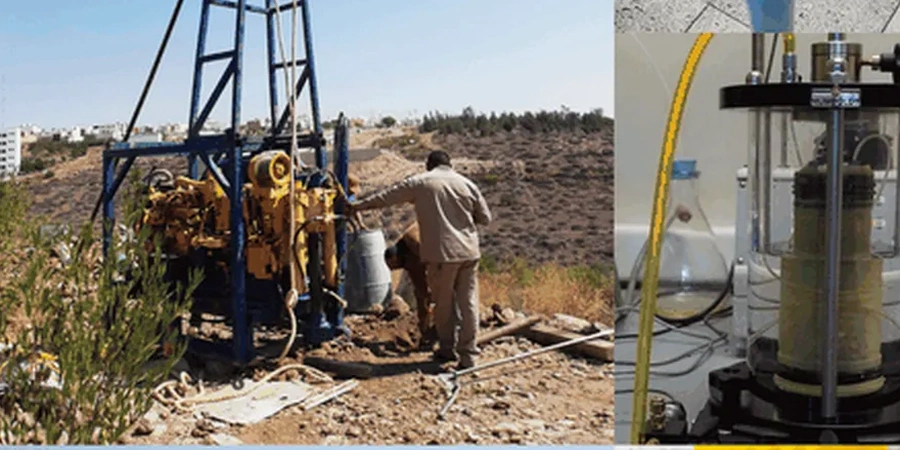
Glacial till in Edinburgh can vary from dense sandy gravel to stiff clay in under two metres — a soil mechanics study is the only way to map that transition.
Scope of work in Edinburgh
Typical technical challenges in Edinburgh
A six-storey building on Morrison Street recently needed a deep raft because the upper 4 m of fill and soft clay showed excessive settlement potential. Without a proper soil mechanics study in Edinburgh, the design would have relied on assumed bearing values from nearby sites — a gamble that fails when you hit a buried channel of peat or a perched water table. We have seen cracks in load-bearing walls appear within two years of construction when the foundation ignored the presence of laminated clay layers. The risk is real, and the cost of a study is trivial compared to underpinning a settled building.
Our services
We offer a full suite of ground investigation works tailored to Edinburgh’s geology. Each service is carried out by our UKAS-accredited laboratory team.
Trial Pits & Boreholes
Machine-excavated trial pits to 4.5 m depth for visual logging and undisturbed sampling, plus rotary boreholes where deeper strata or rockhead is needed.
Laboratory Classification & Strength Testing
Moisture content, Atterberg limits, particle size distribution, triaxial compression (UU and CU), direct shear and one-dimensional consolidation tests.
In‑Situ Testing (SPT, Vane, Dilatometer)
Standard Penetration Tests per BS EN ISO 22476-3, field vane shear in soft clays and flat dilatometer tests for stiffness and lateral stress profiles.
FAQ
What is the purpose of a soil mechanics study in Edinburgh?
Its primary purpose is to determine the bearing capacity, settlement potential and groundwater conditions at a specific site. Edinburgh’s glacial till and soft clays vary over short distances, so a study prevents foundation failure and ensures compliance with BS 5930 and Eurocode 7.
How much does a soil mechanics study cost in Edinburgh?
For a typical residential or small commercial project, the range is £2,360 – £3,550. That includes trial pits, standard laboratory tests and a factual report. Larger sites with boreholes or complex groundwater monitoring sit at the upper end.
What is the difference between N SPT and undrained shear strength?
N SPT (blow count) is an in-situ measure of soil resistance to penetration, used mainly in granular soils and stiff clays. Undrained shear strength (cu) comes from laboratory triaxial or field vane tests and applies to saturated fine-grained soils. Both are needed for a complete soil mechanics study in Edinburgh because the ground profile typically contains both granular till and cohesive clays.
How long does a soil mechanics study take?
A standard study with trial pits, sampling and laboratory testing takes 3 to 5 working days on site plus 2 weeks for lab work and reporting. If rotary boreholes or groundwater monitoring wells are needed, add another week. We always deliver a programme before mobilisation.