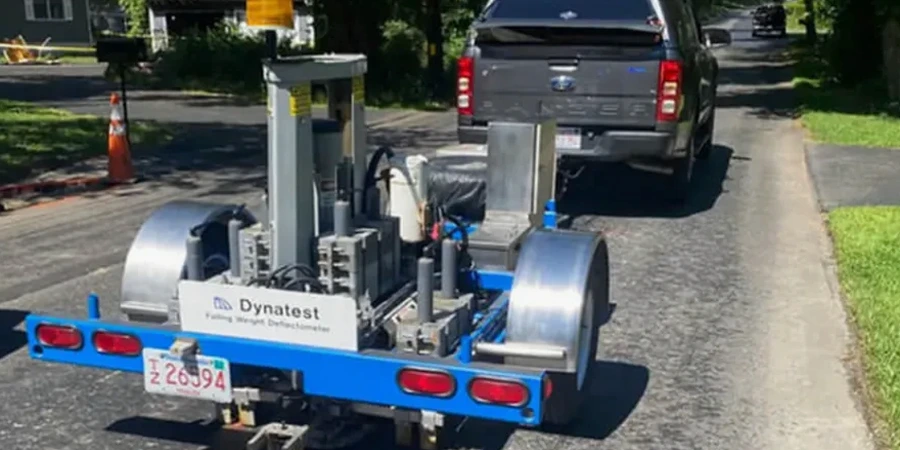
Edinburgh sits on a mix of glacial till, raised beach deposits, and Carboniferous sedimentary bedrock, creating variable subgrade conditions beneath the city’s road network. When we assess an existing pavement, we need to understand not just the surface condition but the structural capacity of every layer down to the formation. Our approach combines falling weight deflectometer surveys, dynamic cone penetrometer profiles, and selective coring to map stiffness variations across the pavement. Before interpreting results we often run a complementary ensayo CBR in the laboratory to correlate field plate load data with the subgrade’s California Bearing Ratio. That correlation is essential when the existing pavement shows surface cracking or rutting — it tells us whether the failure is in the asphalt or deeper in the subgrade.
We’ve measured subgrade CBR values from 2.5% in soft zones near the Water of Leith up to 15% in the boulder clay on higher ground.
Scope of work in Edinburgh
Typical technical challenges in Edinburgh
In Edinburgh we often see old pavements with a thin asphalt layer over a granular base that has never been tested for stiffness. The risk is that a simple visual survey misses a soft subgrade that will cause fatigue cracking within two winters. We’ve also encountered old coal workings in the eastern suburbs that create sudden void collapses under traffic loads. That’s why our evaluation always includes a void-detection scan before we recommend any overlay thickness. If we find high moisture content in the sub-base during coring, we flag it immediately — that water is the main driver of long-term pavement deterioration in this climate.
Our services
We deliver a complete existing pavement evaluation service in Edinburgh, from field deflection testing to laboratory characterisation and structural capacity analysis.
Falling Weight Deflectometer Survey
FWD testing at 10–20 m intervals with back-calculation of layer moduli using ELMOD software. We cover single-lane roads up to dual carriageway sections.
Pavement Coring & Profile Logging
100 mm diameter cores through asphalt and granular layers. We log thickness, material type, binder condition, and take bulk samples for laboratory testing.
Subgrade Stiffness & CBR Assessment
In-situ DCP and plate load tests combined with laboratory CBR and triaxial testing to determine the subgrade’s design modulus for overlay and rehabilitation designs.
FAQ
How does Edinburgh’s glacial till affect existing pavement evaluation results?
The till is dense but contains cobbles and boulders that can give misleadingly high DCP readings if the cone hits a stone. We always correlate DCP results with FWD deflection bowls and laboratory CBR values to avoid overestimating the subgrade’s stiffness. In areas where the till is weathered near the surface, the upper 300 mm can have a CBR as low as 3% even though deeper layers are competent.
What is the typical cost range for a full existing pavement evaluation in Edinburgh?
For a standard road section (up to 500 m), the evaluation including FWD survey, coring at 5 locations, and laboratory CBR and granulometry costs between £1.090 and £3.220. Larger projects, airfield pavements, or sites requiring additional GPR scanning fall at the higher end of that range.
Which UK standards apply to pavement evaluation in Scotland?
We follow HD 29/08 from the Design Manual for Roads and Bridges for structural assessment, BS EN 12697-26 for asphalt stiffness testing, and BS 1377-9 for in-situ CBR. For airfield pavements, we also reference FAA AC 150/5370-11B. Scottish trunk road projects often require adherence to Transport Scotland’s supplementary guidance.
How long does a pavement evaluation take from field work to report delivery?
Field work for a typical 500 m section takes one day with a two-person crew. Laboratory testing (CBR, triaxial, granulometry) adds 7–10 working days. The full report with back-calculated moduli and overlay recommendations is delivered within 14 working days from the field visit.