In Edinburgh the ground profile changes fast. You can be on stiff till one block and soft alluvium the next. That is why we run triaxial tests under BS 1377:1990 and Eurocode 7. The city sits on a mix of glacial till, raised marine deposits and fluvial sands along the Water of Leith. For any medium-rise building or basement excavation the undrained shear strength and effective stress parameters must be measured. We use digital load frames and pore-pressure transducers to capture the soil's real response. Before we start the test we always check the sample quality. A disturbed sample in Edinburgh clay gives you numbers that mean nothing.
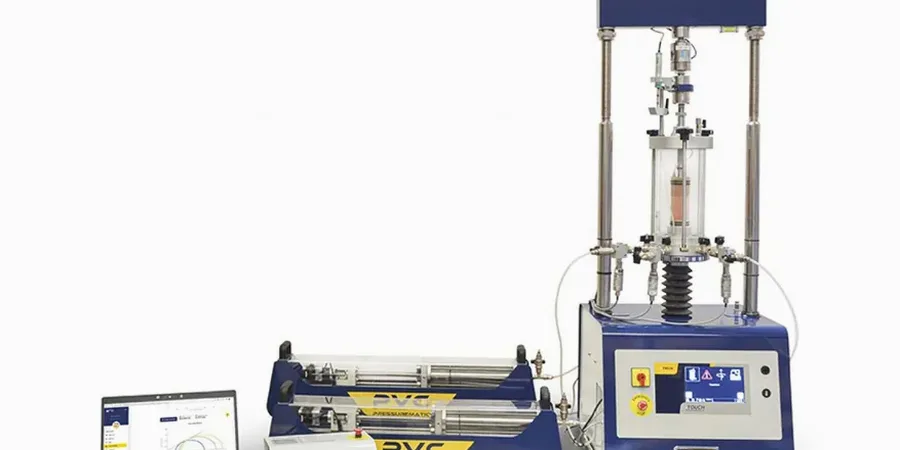
In Edinburgh's variable glacial till a single triaxial test is not enough. Three samples at different depths give you the real profile.
Scope of work in Edinburgh
Typical technical challenges in Edinburgh
The most common mistake we see in Edinburgh projects is running only UU tests on till samples. That gives you a high undrained strength that looks safe. But when the excavation stays open for weeks the pore pressures dissipate. The effective stress drops and the slope creeps. We have seen temporary works fail because the design assumed su from a quick UU test. For any cut deeper than three metres you need a CU test with pore pressure measurement. That gives you the real drained strength. The other error is testing only one sample depth. Edinburgh till can change from sandy silt to stiff clay within two metres. One test does not represent the stratum.
Our services
We deliver two standard triaxial test configurations. Both are carried out in our Edinburgh lab under the same quality system.
Consolidated Undrained Triaxial (CU) with pore pressure measurement
For projects where drainage is uncertain during construction. We saturate the sample, consolidate it under the estimated overburden, and shear it at a controlled rate while recording pore pressure. The output includes effective stress parameters c' and φ' and the undrained strength su. Common in Edinburgh for retaining wall design and slope stability analysis in till.
Unconsolidated Undrained Triaxial (UU) on undisturbed samples
A faster test for immediate undrained strength. No drainage is allowed during shearing. This test is used for short-term stability checks on shallow foundations and temporary excavations. We run it on 38 mm diameter samples from thin-walled tubes. The result is total stress strength su. Often required by structural engineers for pad foundation sizing in Edinburgh clay.
Visual overview
FAQ
How many triaxial tests do I need for a typical Edinburgh basement project?
For a basement up to two storeys deep we recommend at least three CU tests at different depths within the till layer. Edinburgh till is heterogeneous so a single test may miss a weaker zone.
What is the difference between CU and UU triaxial tests in glacial till?
UU tests give undrained strength only. CU tests with pore pressure measurement give both undrained and drained parameters. In Edinburgh till the drained friction angle is typically 3 to 6 degrees lower than the undrained value. That difference matters for long-term slope stability and retaining wall design.
Can you run triaxial tests on disturbed samples from trial pits?
No. Triaxial tests require undisturbed samples. For Edinburgh trial pits we take block samples or drive thin-walled tubes into the base. If the sample is disturbed during extraction the results are unreliable. We always inspect the sample before testing and reject any with visible cracks or extrusion damage.
How long does a consolidated drained triaxial test take?
A full CD test on Edinburgh clay can take seven to ten days. The consolidation stage alone may take two to three days for low-permeability till. We recommend planning the testing schedule early in the design phase. For faster results the CU test with pore pressure measurement is a good compromise and takes three to four days.
What sample size do you use for Edinburgh boulder clay?
We use 50 mm diameter samples for most Edinburgh till. The 70 mm size is better when the clay contains gravel or cobbles. For very stiff till we sometimes use the 38 mm size to fit the sample into the triaxial cell. The choice depends on the core diameter from the drilling rig and the maximum particle size in the soil.