Edinburgh sits on a complex mix of glacial tills, raised beach deposits, and soft estuarine clays. The Forth Valley, in particular, contains layers of soft to firm silty clay with organic content. These deposits are notorious for long-term settlement under load. Our oedometer consolidation test measures how these soils deform over time. We determine the coefficient of consolidation (Cv), compression index (Cc), and preconsolidation pressure directly from undisturbed samples. Before designing shallow foundations or embankments in the city, we recommend pairing this test with an ensayo SPT to correlate strength and stiffness across the profile. The data helps us predict differential settlement on Edinburgh's variable ground.
In Edinburgh's soft clays, preconsolidation pressure can be as low as 50 kPa, making slab-on-grade foundations risky without Improvement.
Scope of work in Edinburgh
- Cv (coefficient of consolidation) – typically 2–10 m²/year in local clays
- Cc (compression index) – ranges from 0.1 to 0.5
- Preconsolidation pressure – often 50–150 kPa in normally consolidated soils
- Void ratio – initial values between 0.6 and 1.2
Working video
Typical technical challenges in Edinburgh
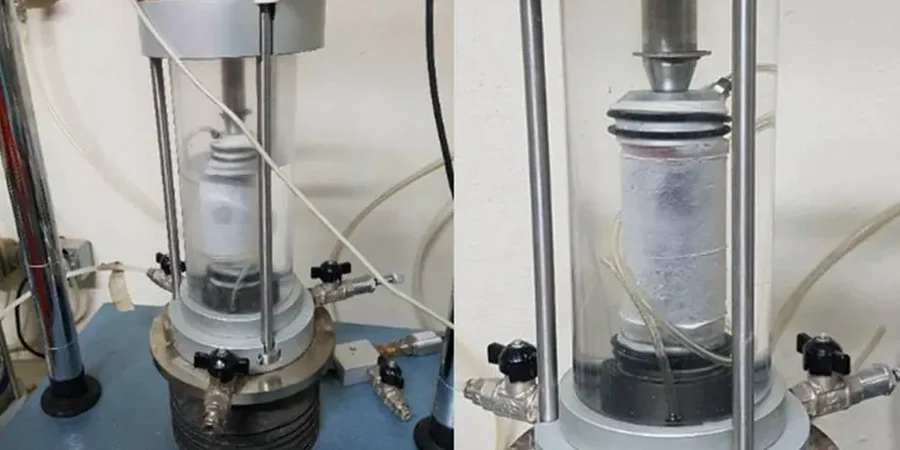
We use fixed-ring oedometers with electronic displacement transducers. The sample ring is 75 mm in diameter and 20 mm high. We trim the specimen directly from the undisturbed tube sample. In Edinburgh, the biggest risk is sampling disturbance in the soft clays. If the sample is disturbed, the preconsolidation pressure drops artificially. That leads to overestimated settlements. We run checks on the initial void ratio against field density to flag anomalies. Every test includes a final moisture content measurement to verify saturation.
Our services
We offer a full suite of laboratory tests to complement the oedometer consolidation test in Edinburgh. Each service supports the next, from initial classification to advanced parameter determination.
Oedometer Test – Incremental Loading
Standard multi-stage loading per BS 1377-5. We apply 8–12 load increments from 12.5 kPa to 1600 kPa. Suitable for settlement analysis on Edinburgh's soft clays.
Oedometer Test – Constant Rate of Strain (CRS)
Faster alternative for low-permeability soils. We control the strain rate and measure pore pressure at the base. Ideal for deep clay layers under embankments.
Swelling Pressure Test
Measures the swelling pressure of expansive clays. Relevant for sites in Edinburgh with high plasticity tills. We use the constant volume method.
Permeability Test on Consolidation Samples
We determine the coefficient of permeability (k) during the consolidation test using the log-time method. Useful for drainage design and dewatering plans.
FAQ
What is the difference between Cv and Cc in the oedometer test?
Cv is the coefficient of consolidation, which describes the rate at which pore water dissipates under load. Cc is the compression index, which tells you how much the soil volume decreases per log cycle of stress. Both are needed to calculate settlement magnitude and time rate for Edinburgh's clays.
How much does an oedometer consolidation test cost in Edinburgh?
The typical range for a standard incremental oedometer test is between £180 and £330 per sample. This includes trimming, loading to 1600 kPa, and a full report with time-settlement curves. Volume discounts apply for multiple samples from the same project.
When should I request an oedometer test instead of a triaxial test?
Use the oedometer when you need settlement parameters (Cv, Cc, preconsolidation pressure) for fine-grained soils under vertical loading. Use a triaxial test when you need shear strength parameters (c', phi') for slope stability or bearing capacity. In Edinburgh, we often run both for embankment designs on soft clay.