Geotechnical laboratory testing forms the backbone of safe and efficient construction across Edinburgh, providing the essential data engineers need to understand ground behaviour before, during, and after project delivery. This category encompasses a comprehensive suite of physical and mechanical tests on soil and rock samples recovered from site investigations, ranging from classification and compaction assessments to advanced strength and deformation analyses. In a city where historical infrastructure meets ambitious modern development, the role of the laboratory extends beyond routine compliance; it delivers the parameters that govern foundation design, earthworks specifications, and slope stability assessments. By replicating in-situ conditions under controlled environments, these tests reveal how local soils will respond to loading, moisture change, and long-term consolidation, directly influencing the safety margins built into every structure from tenement refurbishments to major transport schemes.
Edinburgh’s geological setting presents a particularly varied profile that demands careful laboratory characterisation. Much of the historic core rests on glacial till, a heterogeneous mixture of clays, silts, sands, and cobbles laid down during the last ice age, which can exhibit unpredictable drainage and strength properties. Beneath and around the volcanic plugs of Arthur’s Seat and Castle Rock, the bedrock transitions from sedimentary sandstones and mudstones of the Carboniferous period to igneous intrusions, creating abrupt changes in bearing capacity and excavatability over short distances. The city’s coastal margins along the Firth of Forth introduce estuarine alluvium and raised beach deposits, often soft and compressible, while former industrial areas may conceal made ground of variable composition. This geological patchwork means that a triaxial test on a till sample from one site can yield markedly different effective stress parameters from another just streets away, underscoring the necessity of site-specific laboratory programmes.
All laboratory work in Scotland operates under the framework of British Standards and Eurocode 7, specifically BS EN 1997-2:2007 which governs ground investigation and testing. The execution of individual tests follows recognised protocols such as BS 1377 for soils, BS EN ISO 17892 for geotechnical laboratory tests, and BS EN 932 for aggregate testing. For road and highway projects, a laboratory CBR test is typically performed in accordance with BS EN 13286-47 to assess subgrade strength for pavement design. The UK Specification for Ground Investigation, including the second edition published by the Institution of Civil Engineers, provides additional contractual and quality assurance requirements that reputable Edinburgh laboratories follow. Crucially, UKAS accreditation to ISO/IEC 17025 is the benchmark for demonstrating technical competence, and consultants routinely specify that testing must be carried out by accredited facilities to ensure results are defensible and compatible with the rigorous demands of Scottish building warrants and planning conditions.
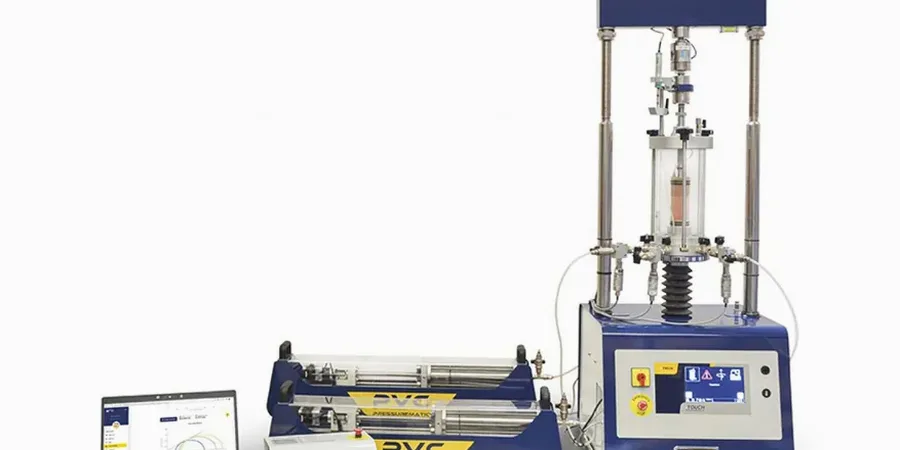
The types of projects that rely on this category are diverse and deeply embedded in Edinburgh’s built environment. Residential developments on the city’s expanding fringes require consolidation testing, such as the oedometer consolidation test, to predict settlement of soft alluvial soils under new housing loads and to design ground improvement where necessary. Infrastructure upgrades, including the tram extension and flood alleviation schemes, depend on shear strength parameters from advanced triaxial testing to model excavation stability and retaining wall performance. The restoration and conversion of Edinburgh’s iconic listed buildings often trigger a soil mechanics study to assess whether existing foundations can tolerate altered loadings or if underpinning is needed. Even minor works like basement excavations in the New Town demand laboratory particle size distributions and Atterberg limits to manage groundwater control and party wall risks, highlighting how geotechnical testing permeates projects of every scale.
Quick answers
What types of geotechnical laboratory tests are typically required for a residential development in Edinburgh?
A suite usually begins with classification tests such as moisture content, Atterberg limits, and particle size distribution to characterise the glacial till or alluvial soils common across the city. Depending on the foundation design, this is often followed by mechanical tests like oedometer consolidation for settlement prediction, triaxial compression for shear strength, and possibly CBR tests if access roads are involved. The exact programme is dictated by the ground conditions encountered during the site investigation and the requirements of Eurocode 7.
How do British Standards influence laboratory testing procedures in Scotland?
British Standards, particularly BS 1377 and BS EN ISO 17892, prescribe the apparatus, methodology, and reporting for virtually all routine and advanced soil tests. They ensure consistency and repeatability across different laboratories, which is essential when results are used for design. In the UK, these standards are harmonised with Eurocode 7, and adherence is typically mandatory under planning conditions and building warrant applications, forming the basis for UKAS accreditation audits.
Why is UKAS accreditation important when selecting a geotechnical laboratory in Edinburgh?
UKAS accreditation to ISO/IEC 17025 provides independent verification that a laboratory operates a quality management system and demonstrates technical competence to perform specific tests. For Edinburgh projects, this matters because consultants, local authorities, and insurers rely on accredited results to be legally defensible and technically robust. Using a non-accredited facility risks data rejection, project delays, and potential non-compliance with the UK Specification for Ground Investigation, which strongly recommends accredited testing.
How long does a typical laboratory testing programme take for a medium-sized Edinburgh site?
Timescales depend on the test types and soil conditions, but a standard programme for a medium development typically requires four to eight weeks from sample receipt. Classification tests can be completed within a few days, whereas consolidation tests may run for one to two weeks per sample due to the required loading increments. Advanced triaxial tests with pore pressure measurement take longer to set up and execute. Reputable laboratories will deliver a clear schedule, and any organic silts or clays from the Forth basin may extend testing durations.