Edinburgh sits on a complex mix of glacial tills, raised beach deposits, and soft estuarine clays along the Forth. These saturated fine-grained soils often exhibit low undrained shear strength, making them tricky for shallow foundations. The field vane shear test (VST) provides a direct measure of this strength without disturbing the soil structure. It is particularly useful in the soft clays of Leith Docks and the Meadows area, where previous construction has encountered settlement issues. Before interpreting results, it helps to cross-check with a study of mechanical soil properties from borehole samples to correlate strength with index properties.
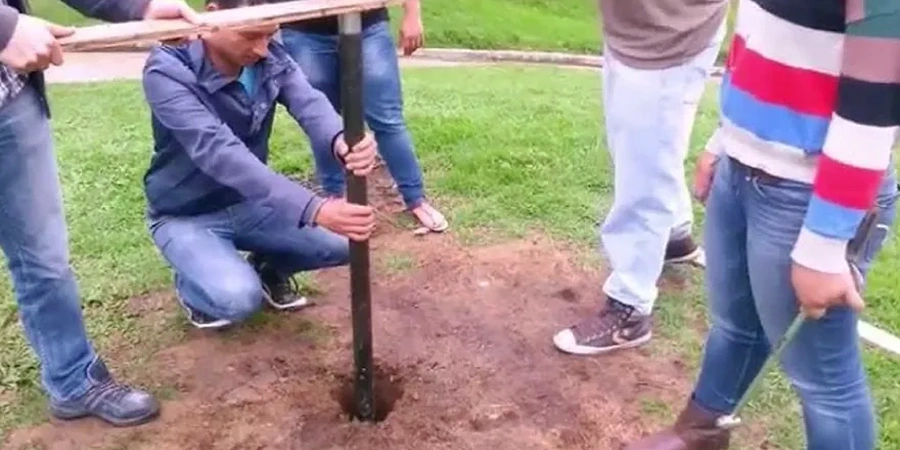
In Edinburgh's soft clays, the vane shear test gives a direct, undisturbed measure of undrained strength that lab testing often cannot match.
Scope of work in Edinburgh
- Peak torque (Tmax)
- Remoulded torque (Trem)
- Undrained shear strength (cu)
- Sensitivity (St)
- Test depth and vane geometry
Typical technical challenges in Edinburgh
The contrast between the firm boulder clay on the Braid Hills and the soft alluvial silts of the Water of Leith corridor is stark. A building on the former may need only strip footings, while one on the latter could track record differential settlement. The field vane shear test in Edinburgh helps quantify this risk directly. Relying solely on blow counts from a standard penetration test in these plastic clays can underestimate sensitivity. The VST gives a true picture of strength loss upon remoulding, which is the primary trigger for foundation failure under cyclic loading or excavation disturbance.
Our services
We offer two complementary VST service tiers tailored to Edinburgh's ground conditions:
Standard Vane Shear Test
Single-point vane test at specified depths (typically 1.0, 2.0, 3.0 m) using a 50x100 mm vane. Includes peak and remoulded readings, Bjerrum correction, and a summary report with cu and sensitivity values. Suitable for small residential projects and preliminary assessments.
Advanced Vane Profiling
Continuous vane profiling at 0.5 m intervals to full borehole depth, with automated torque recording and real-time data display. Includes correlation with laboratory triaxial results and a full interpretive report referencing local Edinburgh soil databases. Ideal for large infrastructure works or sensitive structures near the Forth shoreline.
FAQ
What is the difference between a field vane test and a laboratory triaxial test?
A field vane test measures undrained shear strength in situ without disturbing the soil fabric, while a triaxial test is done on a remoulded or undisturbed sample in the lab. The VST captures natural sensitivity and anisotropy that lab testing may miss, especially in laminated clays common under Edinburgh.
How much does a field vane shear test cost in Edinburgh?
Typical costs range between £510 and £1,190 depending on the number of test points, depth, and whether a full profile or single-point test is required. Mobilisation fees may apply for sites outside the city centre. Contact us for a detailed quote based on your project scope.
At what depths can the vane test be performed?
Standard equipment reaches depths from 0.5 m to 30 m, though the practical limit in Edinburgh's stiff tills is around 15 m. In soft estuarine clays, we can push deeper. The vane rod must be inserted without pre-drilling to avoid disturbing the test horizon.
Which soil types are suitable for the vane shear test?
The test is designed for saturated fine-grained soils: clays, silty clays, and clayey silts with undrained shear strength below 200 kPa. It is not suitable for sands, gravels, or stiff overconsolidated tills where the vane may slip or break. In Edinburgh, it works best in the soft clays of the Forth valley and the raised beach deposits.
How is the Bjerrum correction applied to vane test results?
The Bjerrum correction factor (μ) adjusts the measured cu for the effects of vane geometry and soil plasticity. It ranges from about 0.6 for high-plasticity clays (PI > 60%) to 1.0 for low-plasticity clays (PI < 20%). We apply this correction based on the plasticity index of samples from the same borehole.