Edinburgh sits on a complex mix of glacial till, raised beach deposits, and soft alluvial soils along the Water of Leith. This variability means a one-size-fits-all Improvement approach rarely works. We design dynamic compaction programs tailored to each site, starting with a thorough site investigation that includes standard penetration testing to map soil density profiles. Our team then determines the optimal drop weight, drop height, and grid spacing to densify loose fills or granular layers. The goal is to reduce settlement risk and increase bearing capacity before foundations go in. Every design follows BS EN 1997-1 and incorporates local geological data from the British Geological Survey.
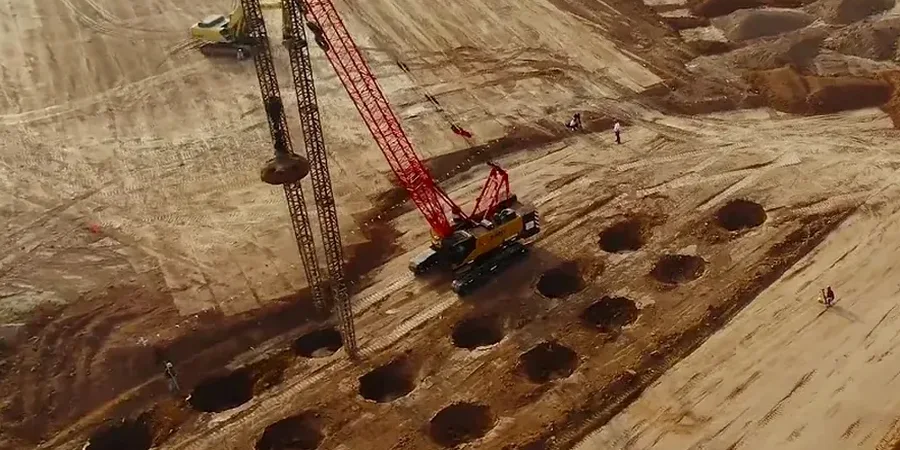
Without proper depth control, dynamic compaction energy can dissipate in the top few metres, leaving deeper loose zones untouched.
Scope of work in Edinburgh
Typical technical challenges in Edinburgh
We worked on a site near Leith Docks where a 15-storey residential tower was planned on made ground from the 19th century. The client had assumed shallow foundations would work. Our dynamic compaction design revealed that the fill was only 4 m thick over soft silt, and that compaction alone could not bridge the transition. We recommended combining dynamic compaction with a vibro stone column scheme to mitigate differential settlement. That decision saved the project from a costly foundation redesign mid-construction.
Our services
We provide four core services around dynamic compaction design in Edinburgh:
Site Investigation & Soil Profiling
Boreholes, SPTs, and geophysical surveys to map the depth and type of soils requiring treatment.
Energy Calculation & Grid Layout
Menard-based energy modelling to determine drop weight, drop height, and spacing for each pass.
Test Cell Verification
Full-scale test cells monitored with settlement plates and post-compaction SPTs to validate design assumptions.
Production QA & Acceptance Criteria
On-site supervision, crater depth monitoring, and final verification using plate load or CPT to confirm achieved density.
Visual overview
FAQ
What is dynamic compaction design and when is it used in Edinburgh?
Dynamic compaction design involves calculating the drop weight, drop height, and grid pattern needed to densify loose granular soils or fills. In Edinburgh, it is often used on brownfield sites with made ground, old railway embankments, or reclaimed land near the Forth estuary where natural compaction is insufficient.
How does Edinburgh's glacial till affect dynamic compaction design?
Glacial till in Edinburgh is typically dense and non-susceptible to compaction. The technique is reserved for the loose alluvial or anthropogenic layers above the till. Our designs always verify the depth of loose material with SPT or CPT before specifying energy levels, so we avoid wasting energy on competent ground.
What is the typical cost range for a dynamic compaction design study in Edinburgh?
The cost for a dynamic compaction design study including site investigation, energy modelling, and test cell verification typically falls between £930 and £3,160, depending on site size, number of test cells, and required laboratory testing. This does not include production compaction works.
How do you verify that the design has achieved the target density?
We use post-compaction SPTs, CPT soundings, and plate load tests at multiple locations across the grid. Acceptance criteria are set in the design phase — typically 70% relative density for sands or a modulus of subgrade reaction above 40 MN/m³ for bearing capacity verification.